During my morning run today, one thought stuck with me: What actually makes a good boss? Recently, I have had the opportunity to get to know many exciting companies in a wide range of industries. Great people, combined with interesting and enriching conversations, have probably led to this thought being so present and have motivated me to write this article.
When I look at the historical development from Industry 1.0 to Industry 4.0, I see some big changes. Since the 18th century, people have allowed themselves to be integrated as a function through technical achievements. At the beginning, still without electricity, new processes were developed to contribute to social welfare. This continuous development of industry, together with the parallel development of knowledge, has led to a new starting point for us today. The challenge, in my opinion, is that these changes have a major impact on the development of the individual. Depending on one’s biography, this can have a constructive and an obstructive effect. If we now compare the development of satisfaction with the corporate culture, which has a considerable influence on the productive performance of a company, with this industrial development, today’s problems can be easily explained. If personal development was neglected, different directions now clash. Especially today, when there are more different generations in the work process than ever before, adaptability is essential. Example: If I learned my leadership skills and business understanding in the age of Industry 3.0, this may be outdated today. The mindset of the following generations is also based on a different socialisation. If we look at the status of knowledge, it becomes clear that we have access to very well-educated employees today (=> education does not necessarily mean training). They also demand more personal responsibility, more transparency, more flexibility, a high degree of digitalisation, a sense of purpose, honest and smooth communication, clear areas of responsibility and a good coach as a leader. If this change is not recognised, it can lead to a widening of the gap and thus dissatisfaction with the corporate culture.
So what do I need to be a “good boss”?
- The spirit of the company is unique. This serves as the basis for corporate development. As a leader, I cannot choose any management model to shape the future. Here, theory can actually play a trick. Empathy, understanding, listening, appreciation and integration serve as prerequisites for success.
- Leadership is not defined by the car, the watch or the house. Leadership is the ability to provide the best possible service to all employees.
- Business is not done on a PC. Business is achieved through customer trust and value creation. As a role model in practice, I reflect this in the organisation and promote this approach.
- As a leader, I don’t have to be the best. I manage to gain access to employees through personality, clarity, honesty and authenticity and value their contribution to the development of the company. To this end, I challenge and encourage them in their personal development and motivate and inspire them as a coach.
- New and shared knowledge serves as a tractive force for good and innovative cooperation. Thus, communication and information are key for the transformation into a successful future.
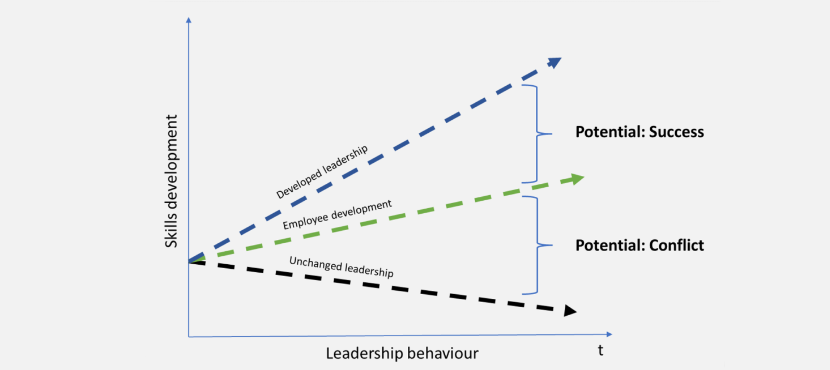
In conclusion, I would say that the development of skills and behaviour in leadership is the key to whether we move towards conflict or towards success.
I look forward to your feedback in the comments.
Best wishes & take care
Stephan