

Decision-making lies at the heart of every leadership role. Yet few periods have been as challenging as the present. Organizations are changing at unprecedented speed, markets are unpredictable, technologies evolve rapidly and teams operate within a landscape marked by diversity, emotional dynamics and differing expectations. In moments of conflict, strategic realignment, deep transformation or personal strain, it becomes clear how grounded a leader truly is and how capable they are of creating clarity, offering orientation and making courageous, well-considered decisions.
From my perspective, complex environments no longer follow straightforward, linear patterns. There is rarely a single correct answer, but rather multiple paths, each entangled with uncertainties and incomplete information. Leaders must make decisions at high velocity while simultaneously tolerating ambiguity, communicating transparently, understanding the emotional realities within their teams and maintaining their own sense of stability.
Traditional decision-making mechanisms struggle under these conditions. Intuition remains valuable but reaches its limits when the context becomes unpredictable. Rationality supports clarity, but loses traction when essential variables are not fully known. This is precisely where leadership coaching becomes deeply relevant.
Effective decisions do not originate solely in the cognitive mind, they arise from a state of inner clarity. When mental overload, emotional reactivity or stress narrow the field of vision, decision quality declines. Access to intuition, experience and creativity becomes restricted. Mindfulness introduces mental spaciousness. It enables leaders to recognize impulses, organise internal dialogue and focus on what truly matters. It brings clarity to complexity and softens the pressure of urgency.
Resilience complements this by strengthening emotional stability. It allows leaders to endure uncertainty, remain composed in conflict and commit to decisions even when they provoke resistance. Together, mindfulness and resilience create the inner framework from which consistent, grounded and authentic decisions can emerge.
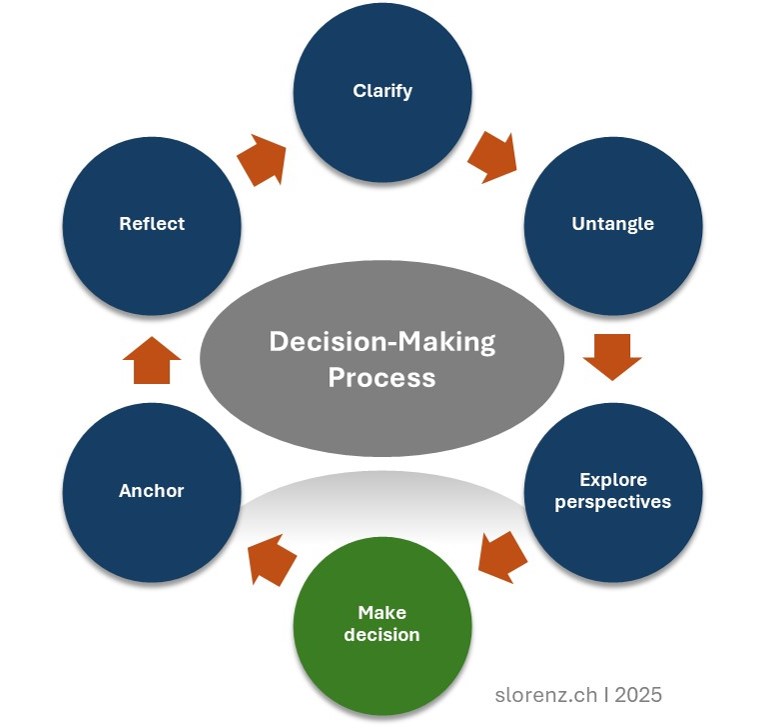
In leadership coaching, I guide executives through a structured decision process informed by systemic understanding and psychological insight.
This begins with clarifying the true nature of the challenge:
➜ What is the core issue?
➜ What dynamics are at play beneath the surface?
➜ Which values or boundaries are affected?
💡 Complexity becomes manageable only when the underlying dynamics are fully understood.
The next step involves disentangling the various influences: strategic, interpersonal, emotional or structural. This creates the distance needed for rational reflection. Once the situation is transparent, new perspectives can be explored. Assumptions are examined, blind spots addressed and alternative directions considered. A decision becomes possible when clarity, purpose and inner coherence align. Finally, the decision must be communicated effectively, anchored within the organisation and reflected upon so that learning becomes part of the process.
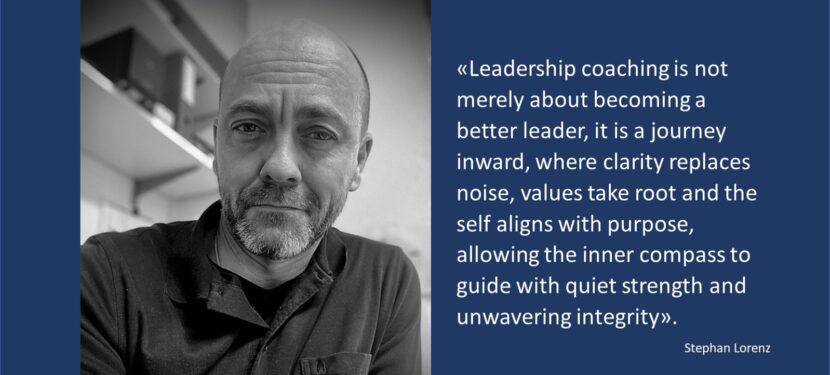
“Leadership coaching is not merely about becoming a better leader, it is a journey inward, where clarity replaces noise, values take root and the self aligns with purpose, allowing the inner compass to guide with quiet strength and unwavering integrity.”
Stephan Lorenz
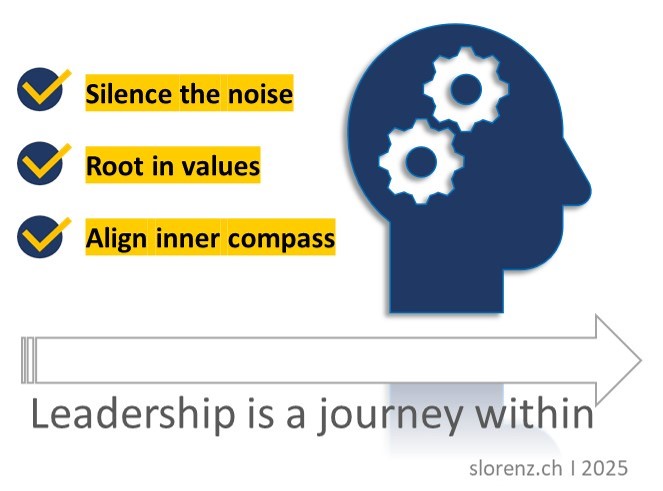
This captures the essence of modern leadership. Decisions become stronger when they emerge from internal alignment, from a clear mind, a regulated emotional system and a deep connection to personal values.
Leaders who understand themselves, including their triggers, boundaries, strengths and intentions, communicate more clearly, act more consistently and navigate uncertainty with greater confidence.
💡 Decision-making becomes not only a managerial task, but an expression of integrity.
My own experience has shown me how emotionally and strategically demanding many decisions are. They often involve more than analytical reasoning. They reflect the interplay of strategy, culture, team dynamics, emotions and structural realities. Leaders face conflicts, strategic dilemmas, reorganisations, cultural shifts or the constant feeling of being under pressure. In such environments, a grounded, calm and focused decision-making approach becomes essential.
🔎 Focusing on what truly matters, reducing complexity without oversimplifying, understanding the people involved and ensuring that decisions are culturally and structurally sustainable.
👉 These are central pillars of effective leadership.
I value heuristics because they provide practical mental shortcuts that help navigate complexity, allowing leaders to focus on what truly matters without losing sight of nuance or context.
Leadership coaching offers a protected space to navigate decisions with greater awareness. It helps leaders understand complex situations more deeply, dissolve inner blockages, approach conflict constructively, cultivate resilience and strengthen presence.
💡 Decisions do not necessarily become easier, but the executive becomes clearer, calmer and more capable of acting with purpose. This clarity radiates into the organisation and positively influences the entire system.
In times of change, crisis and uncertainty, organisations need leaders who understand themselves, who perceive their environment consciously and who are grounded in their values. Mindfulness, resilience and systemic awareness form a solid foundation for this.
Leaders who can guide themselves are better equipped to guide others, especially in complex or unpredictable situations. Decision-making then becomes not just a responsibility, but an expression of authenticity, stability and inner strength.
If you are confronted with important decisions and clarity feels out of reach, I am here to support you as your coach.
Best regards
Stephan


